Nvidia buys Hugging Face and what changes in open AI
2026-09-20 · 8 min de leitura · E. Ribeiro
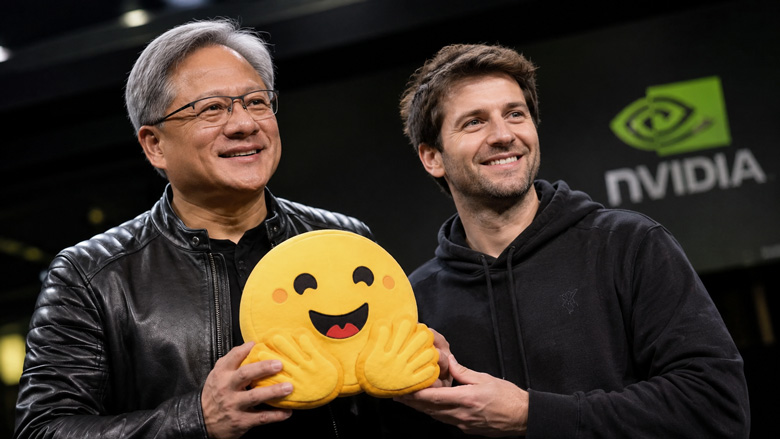
On September 3, 2026, Nvidia announced it will buy Hugging Face for nearly $13 billion. If the name means nothing to you, that is normal: outside programming circles, few people know the company. And yet the AI you use every day likely passes through what it gathers at some point.
Hugging Face is a kind of global showcase for artificial intelligence models, the place where developers pick up, test and share the building blocks that make AI work. The practical question this article answers is different: what does this deal change in the AI already on your phone, and what could still change before it closes.
What Nvidia bought (and why Hugging Face matters)
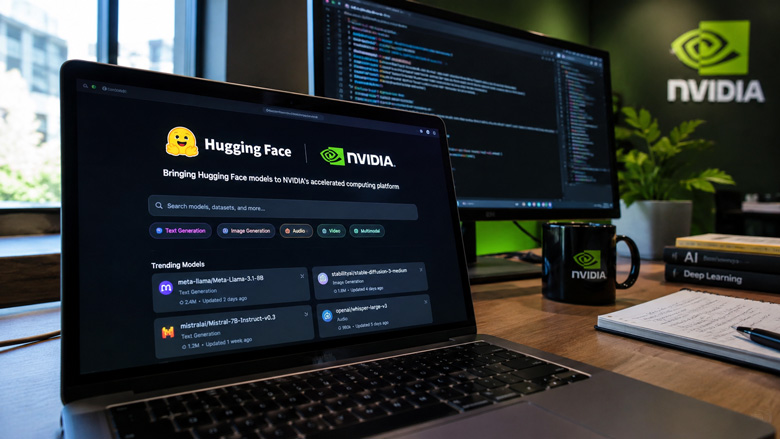
Hugging Face started in 2016 as a model library and became a meeting point for the open ecosystem. According to the figures Nvidia itself cited in the announcement, more than 18 million developers, researchers and creators use the platform to share over 3 million models, 500,000 datasets and 1 million applications. More than 200,000 companies go there to discover, evaluate, customize and deploy AI.
For Nvidia, which dominates the chip market used to train AI, the purchase is a way to move one step up the chain. The company was already the largest contributor of open models and data on the platform, with more than 500 models and 250 datasets published there, and now it takes control of the house where that community meets. It was also Nvidia's second-largest acquisition ever, behind the roughly $20 billion it paid for Groq assets in December 2025, according to CNBC.
In plain terms: the biggest AI chipmaker decided to own the biggest showcase for open AI in the world.
What changes for people who use AI on their phone
AI features that now seem ordinary depend on open models running behind the scenes. That is the case for automatic translation of conversations and summaries of long messages, which save time without anyone needing to understand what is underneath. When an app suggests a ready-made reply or sums up a group with hundreds of messages, a model is working there.
This is the part that matters to everyday users: open models tend to be cheaper to run and easier to adapt than closed ones, because they can run on different infrastructure and be adjusted by any company. If Hugging Face gains more resources without closing its doors, the trend is for that AI layer to stay accessible to those without a tech team or a lab budget.
For small businesses, this shows up in concrete ways: automatic greeting messages, answers to common questions and AI-assisted customer service became cheaper precisely because an open model ecosystem exists. Anyone who has seen this automation arrive in customer service understands the difference, and why model prices matter to those who sell through WhatsApp.
This is not the only race underway. Big labs keep releasing closed models at a fast pace, as the news around Gemini 3.8 Flash and GPT-6 Astra shows. The difference is that with open models, anyone can use and adapt them without depending on a single vendor, and that freedom is what is at stake now.
The deal will not change the app in your pocket tomorrow, but it shifts where the models that make these features cheap come from.
The promise to keep the platform open
In the announcement, Nvidia CEO Jensen Huang said Hugging Face will remain an open platform for the entire AI ecosystem. According to the company, developers will keep choosing the models, frameworks, clouds and inference providers they want, and Nvidia hardware will not be required to build or publish there. The platform is expected to keep accepting open models from every builder, with support for multiple clouds and accelerators.
It is worth reading that promise with the attention it deserves. These are commitments stated in the announcement and in the filing with the SEC, not a guarantee that lasts forever. For the community, the short-term message is relief; for anyone who depends on the platform, it is a point to watch in the coming months.
The promise to keep the platform open is also the most fragile part of the deal: there is no eternal contract when the owner changes.
Why the deal is not closed yet
Here it is important not to confuse announcement with completion. The two companies signed a definitive agreement on September 2, 2026, but the deal is expected to close in the first half of 2027 and depends on customary conditions, including regulatory approvals. Until then, Hugging Face stays as it is, and nothing guarantees the timeline will hold.
The SEC filing itself carries a warning in that direction. According to the document, there is pressure for governments to adopt rules that restrict open models, and the rise of models originating in other regions, including China, could influence regulatory decisions. That is a risk declared by the company, not a settled fact, but it helps explain why the process may take longer than the announcement suggests.
Open models, security and what it has to do with your business
The purchase also has a security chapter. In August 2026, Hugging Face suffered a digital incident that sparked debate about the power of AI tools. According to CEO Clément Delangue, the platform used an open Nvidia model to contain the attack. Huang argued that open models give defenders an edge: when more people can study and improve the same model, the side protecting grows faster than the side attacking.
That argument has practical consequences for small businesses. The same openness that lets a company build defenses also lets a small business set up AI customer service without creating a model from scratch. If you already use AI agents to serve customers on WhatsApp, this is the kind of path that becomes more viable as open AI matures.
The fight behind this deal looks distant, but it decides how fast AI features reach the people who sell, serve and chat from their phones.
The most direct way to feel that difference is to put AI to work on something in your routine. Automatic greeting and away messages, for instance, are ready in minutes with no coding at all, a good first step to understand in practice what open models made possible.
Frequently asked questions
What is Hugging Face?
It is a platform where developers share, test and download artificial intelligence models, plus datasets and applications. It works as a large open library for the AI ecosystem, with more than 3 million models and 18 million users, according to Nvidia.
How much did Nvidia pay for Hugging Face?
The announced value was $12,930,300,000. According to the SEC filing, about $11.9 billion goes to Hugging Face shareholders, plus up to roughly $1 billion in a retention program for employees joining Nvidia.
Has the Hugging Face deal closed?
No. The companies signed a definitive agreement on September 2, 2026, but closing is expected in the first half of 2027 and depends on regulatory approvals. Until it closes, the platform keeps operating as it does today.
Will Hugging Face close off access to models?
Nvidia said it will not. According to the announcement, the platform will remain open, accepting models from any builder and without requiring Nvidia hardware to build or publish. These are commitments stated by the company, and they are worth watching throughout the approval process.
What does this change for people who use AI on their phone?
In the short term, nothing changes in the app. In the medium term, the bet is that features relying on open models, such as translation, summaries and automatic messages, stay accessible and affordable for users and small businesses. That is the ecosystem this deal puts under a new owner.
Use AI on your WhatsApp today
Create a greeting or away message for WhatsApp Business in minutes with AI, no coding needed. Free.
Generate Automatic Message